M
← Back to the Archive

HYPATIA, ALEXANDRIAN MATHEMATICIAN, 415–2015

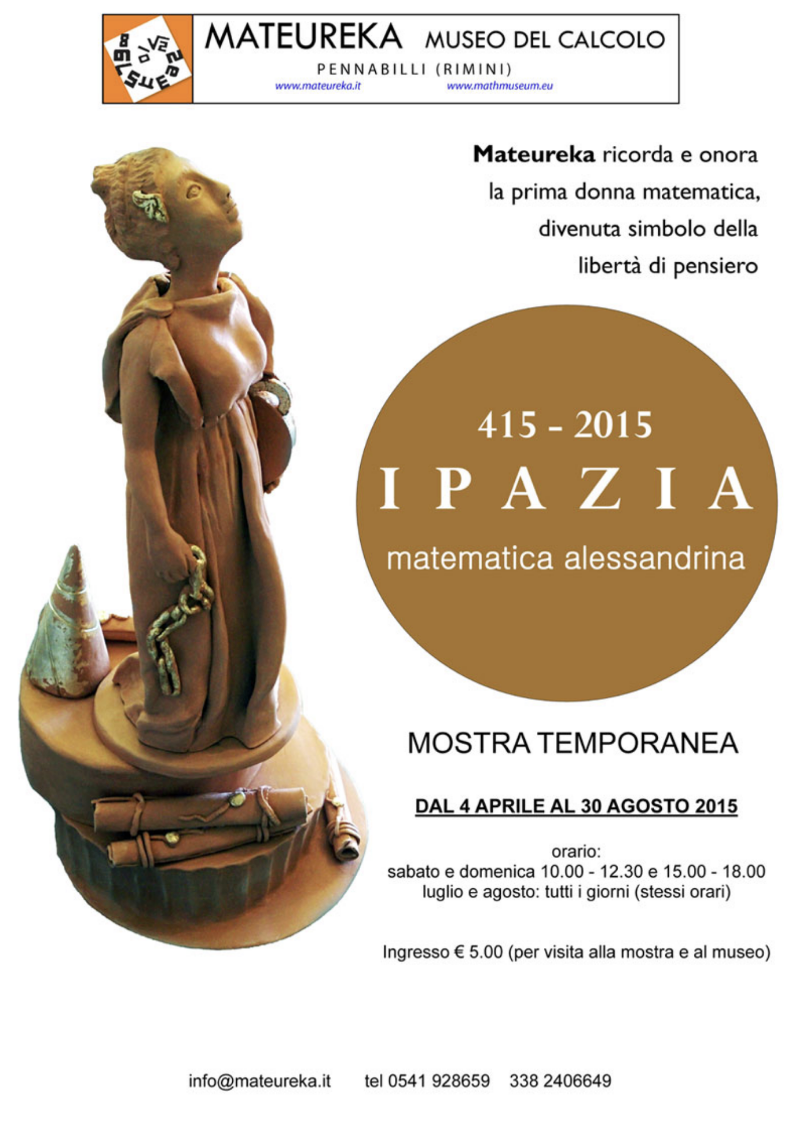
Locandina HYPATIA mathematics alessandrina, 415 – 2015

The Mateureka, Museum of Mathematics and Calculation Mateureka recalls and honors with an exhibition the scientist Hypatia of Alexandria at 1,600 years from his death; exceptional woman, known and studied as a philosopher, but also valuable astronomy and first woman eating whose we have reasonable Information documented.

In the exhibition, set up within the museum, we have deliberately focused our attention only and only on Hypatia’s contribution as a matter.

He belonged to a family of excellent extraction; his father, Theon, was a prominent character, astronomer and museum director of Alexandria, institution from which the great Library, joy of the Hellenic world depended (v. appendix 2).

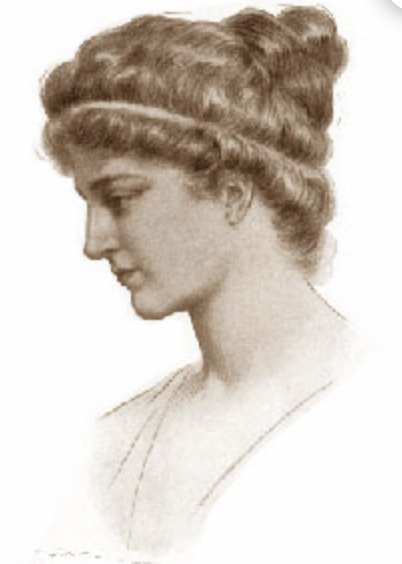
Face of Hypatia
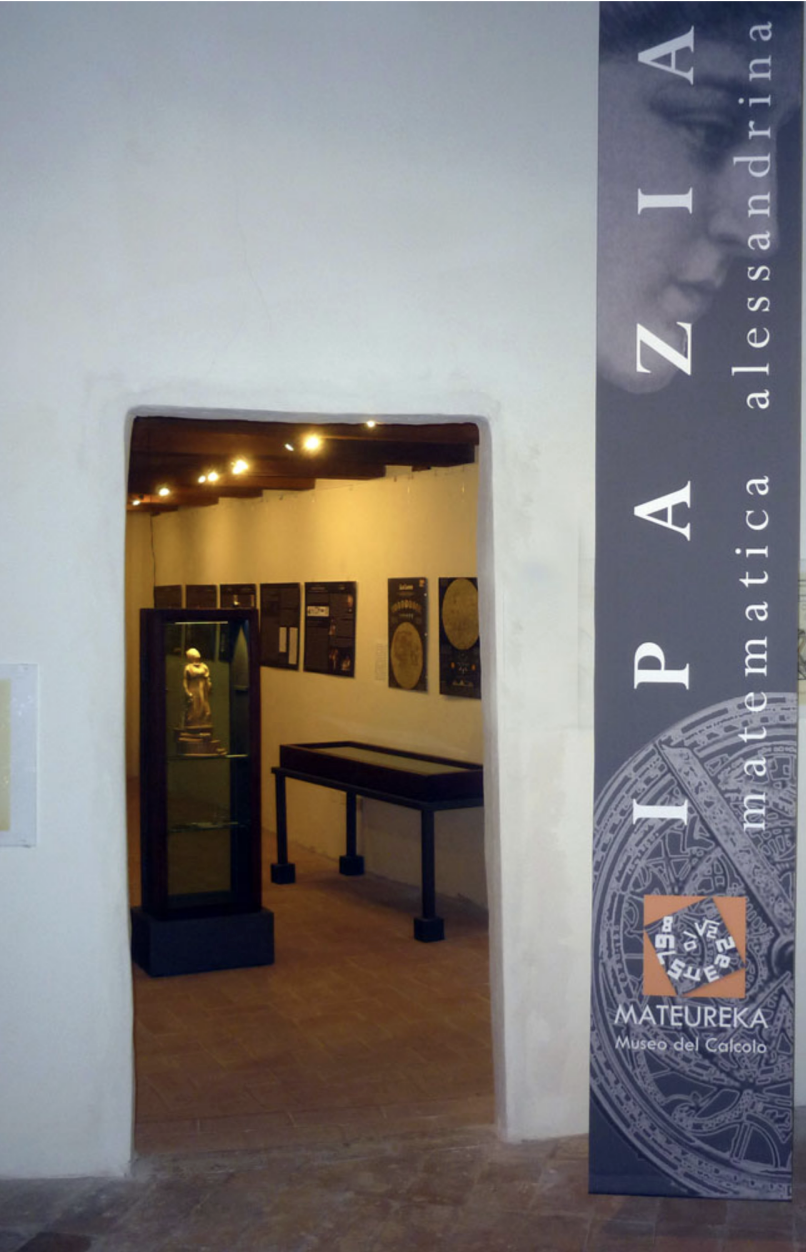
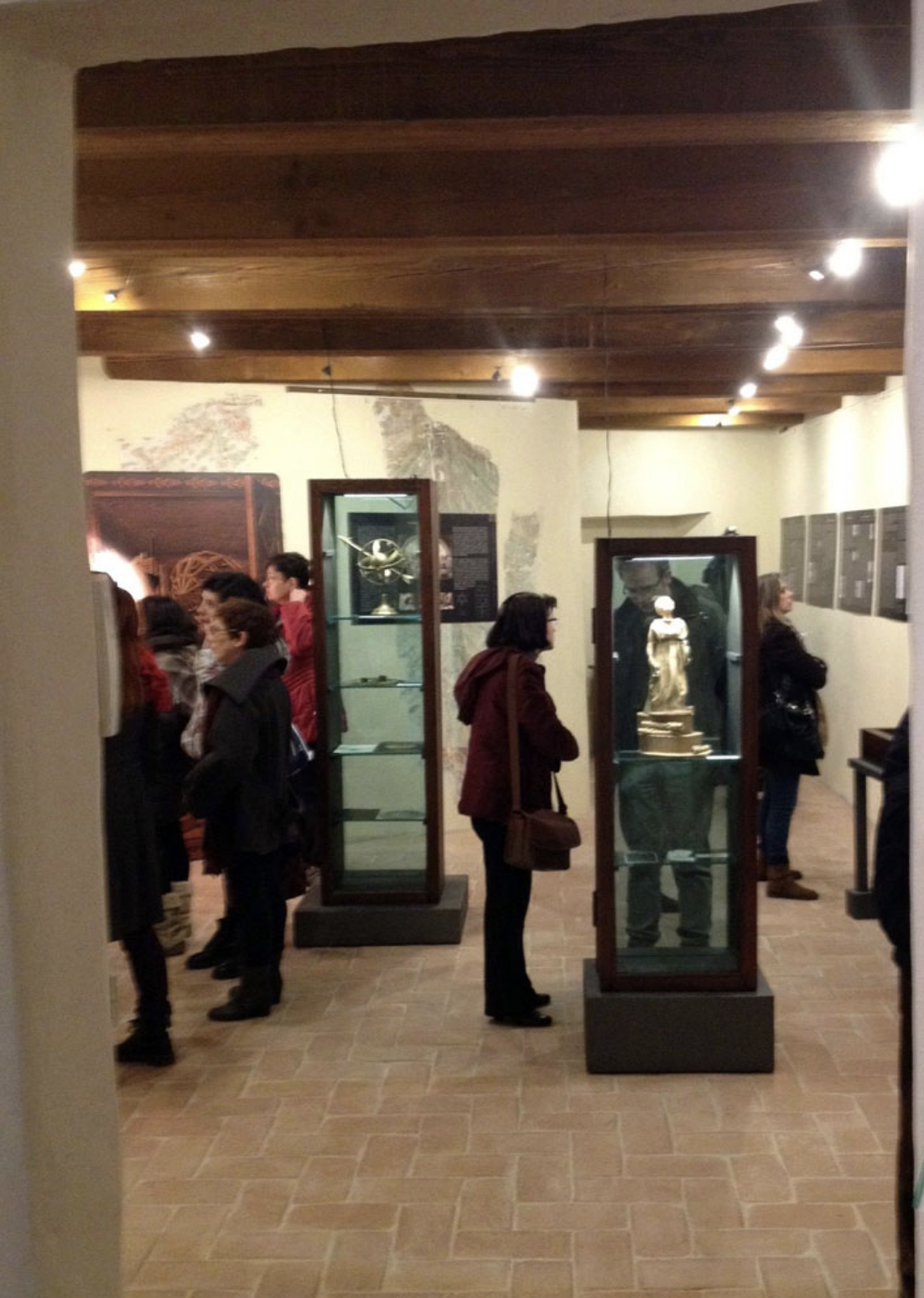
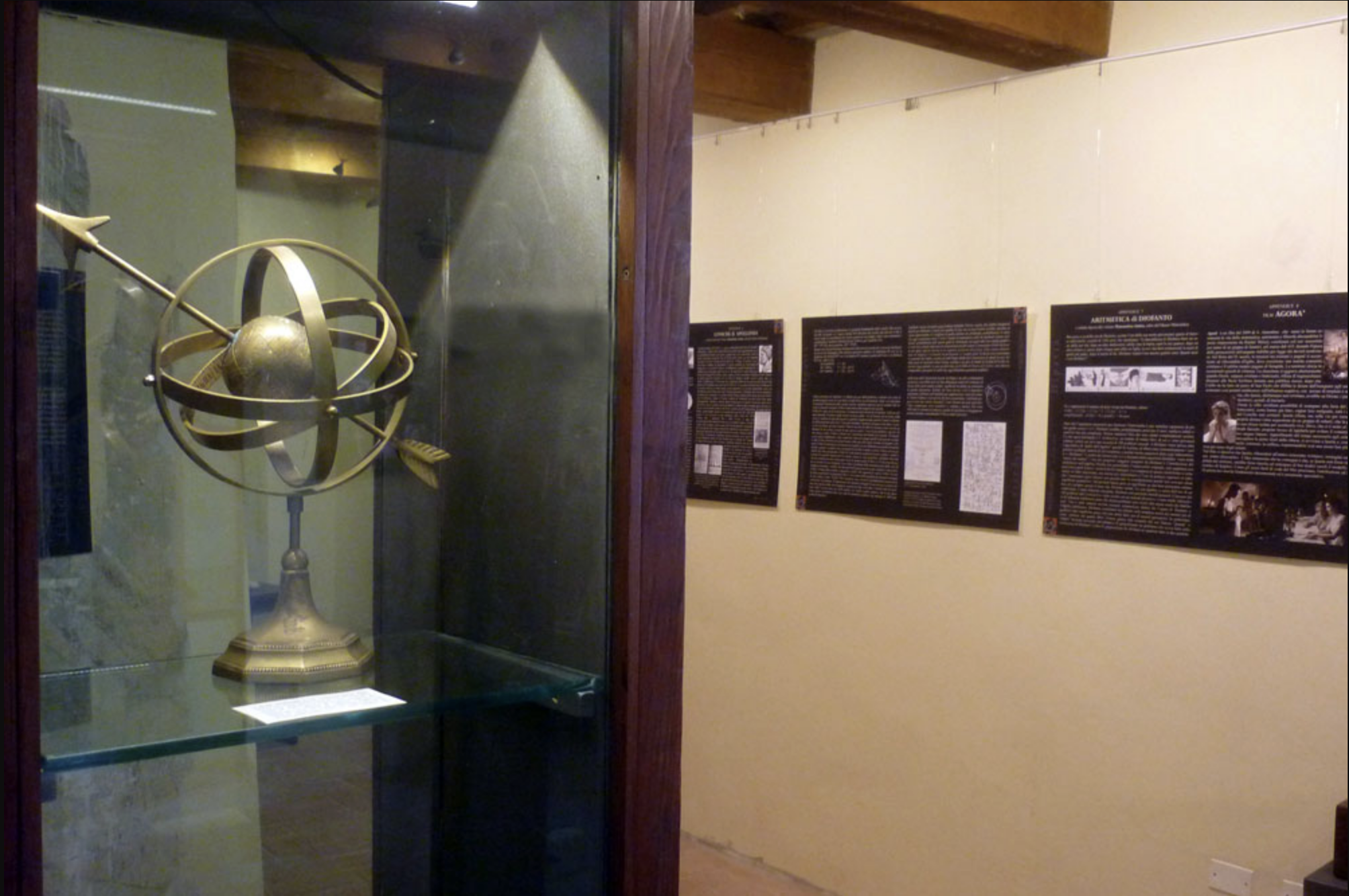
Objects and tools of the exhibition dedicated to Hypatia

According to some witnesses to her neighbors she was gracious of appearance and, given her wisdom, she moved at ease in a world of men, demonstration of an exceptional character, for that time. As Suida says, Byzantine intellectual, and confirms Philostorage, in his Ecclesiastical History: “Hypatia became much better than the master (the father Teone) and ended up being herself a teacher of many in the mathematical sciences.” He had a particularly effective teaching and fluent argument and rushed to Alexandria from all sides to listen to it. After the destruction of the Temple of Serapid, he only taught at home. Little prone to frivolity, had an ascetic nature. We know for sure, because all sources agree to testify to him, that how much Hypatia had died in life and feelings so much was direct, almost brutal, in the way of doing and talking.

Most likely Hypatia was, in its time, the number one in mathematics. Hypatia’s contribution to his father’s activity seems indisputable; for example, although Teone did not invent astrolabe, he actively participated in his development and refinement, and Hypatia largely related with this tool (see Appendix 5 and vertical display case). The comments written by Teone (see Appendix 3) on the greatest work of Ptolemy (about 100- 170), the Almagest, according to some scholars, owe themselves largely to the hand of his loving daughter. Teone considered her superior to herself in mathematics and Damascio, the last school of the Athens Academy, in her Life of Isidoro, she wrote about her as a “woman poured into geometry”.

According to Suida, Hypatia wrote comments to the Conics of Apollonius of Pergamo (262 BCE- 190 BCE) (see Appendix 6) and to the Diophantus’ Arithmetics of Alexandria (200/214 CE-284/298 CE)(v. Appendix 7). The name of Hypatia is then associated with a work called by the astronomical Canon sources, probably a commentary to the Easy Tables of Tolomeo within the commentary of Teone, who writes “released edition by my daughter, the Hypatia philosopher”. Regarding the machines that probably made students build, we can only mention with certainty a flat astrolabe, a hydroscope, which attracted the attention of the great mathematician Fermat, and an aerometer, to stick to what is reported by Sinesium; all the rest is illation, or conjecture. But the great merit of Hypatia and his father Teone, was to preserve the classic texts of mathematics and, among them, especially the Elements of Euclide.
How is the exhibition structured?

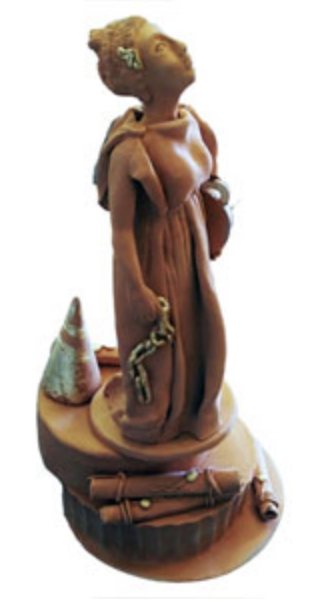
Statue of Hypatia by Professor Lidia Masi

At first the visitor is welcomed by Hypatia, in the form of a beautiful statue, made by Prof. Lidia Masi. The author has been able to create a wonderful and effective synthesis of Hypatia: his face, which is not hellenic but Egyptian and the gaze addressed to the sky that recalls his being astronomy; the bearing and dignified typical of the philosopher, and the astrolabe in hand and the scrolls of the mathematical books to the feet and the cone of the Conics for his being and also the broken chain of the learned

The first display case contains, in paper, the 5 works studied by Hypatia [ELEMENTI (300 BCE) of Euclide; CONICS (220 BCE approximately) of Apollonius; ALMAGEST (150 CE) and ASTRONOMIC CANONE of Ptolemy; ARITHMETIC (250 CE circa) of Diophanto) that are also available in electronic format on computers that contain, moreover, lists of mathematical women and women of science where each figure of the list can be deepened, in addition to a comprehensive bibliography on Hypatia.

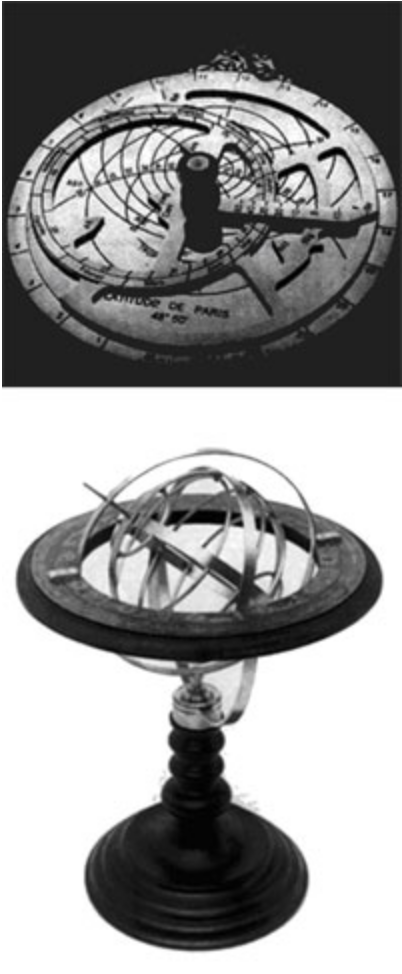
The display case instruments contains, among other things, a wonderful astrolabe and an armillary sphere of the eighteenth century, an instrument already present at the ancient Greeks and scientists of the Far East and was described by Tolomeo, lived in Alexandria in the second century CE and by Teone (about 365), father of Hypatia.

In the screening room you can see some of the pieces of the film Agorà, on the life of Hypatia; movies about Greek mathematics and one about the city of Alexandria, its Library and its lighthouse.

In the modern display case, in evidence, the crater “Hypatia” on the Moon, homage of astronomers to the great scientist and numerous historical and scientific texts served for the realization of the exhibition panels (which contain the ten appendixes).

Among the many, also the great Raffaello Sanzio in his wonderful fresco The School of Athens, dedicated to the pearls of Greek thought, (see Appendix 1 and the painting) and the young Giacomo Leopardi in his History of Astronomy have honoured Hypatia.

The time then made her an icon of feminism, tolerance and freedom of thought.

Finally, it is not possible to remember the other women of mathematics and, more generally, the role of women in science, the theme taken up in appendixes 9 and 10.

Honor and long life to the memory of Hypatia