M
← Back to News

MATEUREKA · NEWS

Ancient Mathematics, a Book by Professor Renzo Baldoni

It is no longer available, because exhausted, the volume Mathematics Ancient, the result of the study and research carried out by the founder of the Museum, prof. Renzo Baldoni.

The book, of 368 pages, with over 1,000 illustrations, photos and patterns and with 120 tabs of study, presents the mathematics and the peculiar aspects of ancient peoples. Based on historical documents – more than 300 cuneiform tablets, 300 papyri and 600 specialist studies analyzed over seven years – it is an invitation to scale the wonderful Mathematics Tree by helping the reader to put their feet, in complete safety and tranquility, on the various branches.
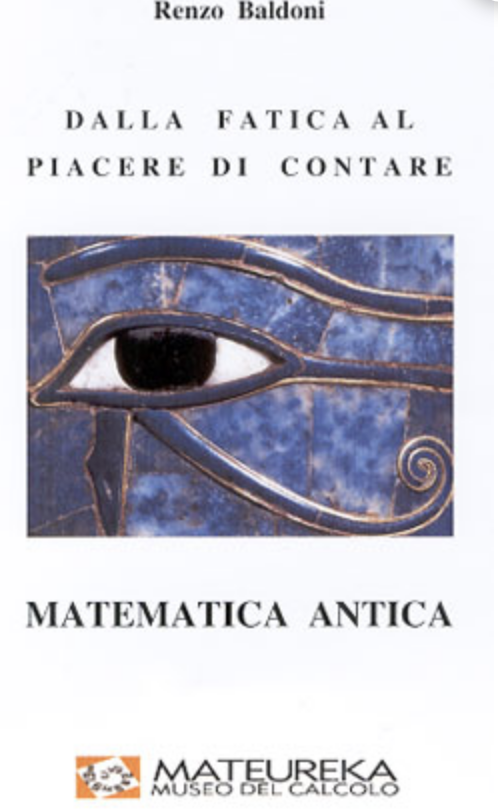
Cover of the volume Mathematics Antica di Renzo Baldoni

Volume index “Mathematics Antica”

( 350 pages, 1,000 illustrations, 120 deepening cards)

First branch: Le Origins of Mathematics (from 30,000 BCE)

(11 pages, 16 illustrations, 5 tabs)

  • The beginning of numbers
  • Count
  • The invention of the base

Schede ”saperne more”:

  • the first equipment
  • the hand
  • the human body, origin of arithmetic
  • Can animals count?
  • the base and numbering systems

Second branch: Babylonian Mathematics (from 3,500 BCE)

(53 pages, 146 illustrations, 19 tabs)

  • Mesopotaemia
  • The principle of position and the invention of zero
  • Basic operations
  • Calculi Sumerians and hermits
  • Sumerical Tablets
  • Sumerian distinct
  • Foundation cone
  • Tablet YBC 7289
  • Table Plimpton 322
  • Shuruppak table
  • Tell Harmall Tablet
  • Table AO 8862

“Saperne” diagrams:

  • a land between two rivers
  • technological progress in Mesopotamia
  • cracks and seals, bolts and tokens
  • origins of writing
  • the invention of cuneiform writing
  • first written documents
  • the sexist system
  • after the Sumerians
  • clay as memory
  • marriage contract
  • Sumerian division
  • abacus sumer
  • the Babylonian zero
  • square roots in Mesopotamia
  • Ziggurat
  • Ebla, the first Library
  • the libraries of the crescent
  • the Babylonian astronomy
  • Virtualmuseumiraq. it

Third branch: Egyptian Mathematics (from about 3,000 BCE)

(57 pages, 175 illustrations, 18 tabs)

  • The Nile: the vital force of Egypt
  • Egyptian figures
  • Historical sources
  • Rhind's papyrus
  • The papyrus of Moscow
  • The papyrus Reisner, the papyrus of Berlin, the papyrus of Kahun
  • Leather roll, wooden tablets

“Saperne” diagrams:

  • Egypt “gift of the Nile”
  • Technological progress in Egypt
  • Egyptian writing: hieroglyphic, ieratic, demotic, copta
  • The papyrus
  • Tendents of ropes
  • Reghello di Kha
  • The Mastaba
  • The pyramids
  • The solar temple
  • The Egyptian astronomy
  • Rosetta stele
  • The palette of Narmer
  • The Eye of Horuz
  • Operations under the pyramids
  • The problem 56 of Rhind's papyrus
  • The Egyptian fractions
  • The geometry of Egyptian boats
  • Egyptian Treasures in the World

Fourth branch: Mediterranean Mathematics (from about 1.700 BCE)

(58 pages, 199 illustrations, 24 tabs)

Hittites

  • Numeration

“Saperne” diagrams:

  • the language of the Hittites
  • the rock written
  • Hattusa
  • Technological progress
  • War wagons

Phoenicians

  • The origin of the linear alphabet
  • The numerical notation of Phoenicians

“Saperne” diagrams:

  • the character of Phoenicians
  • did Phoenicians circumnavigate Africa?
  • Did they also discover America?
  • Ugarit

Jews

  • Hebrew number letters

“Saperne” diagrams:

  • slavery in Egypt
  • the exodus
  • the march in the desert
  • the Bible as a historical source
  • the Bible gives numbers
  • the Jewish calendar
  • Qumran
  • The pi in the Bible
  • The Universe and the Bible
  • Gematria

Minoans

  • The Cretan figures
  • Linear A
  • Linear B

“Saperne” diagrams:

  • Minosse and Dedalo
  • The palace of Cnosso
  • The disco of Festo
  • The Labyrinth of Crete
  • Mycenaean Civilization

Fifth branch: Greek Mathematics (from about 800 BCE)

(129 pages, 392 illustrations, 39 tabs)

  • Letters to count
  • General sources
  • Classical period (600 BCE – 300 BCE)
  • Talete and ion school
  • Pythagoras and the Italian school
  • The Pythagoreans and Music
  • The Pythagoric astronomy
  • The Eleatic School
  • Elea Zenone

“Saperne” diagrams:

  • Greece, the first major European civilization
  • Greek technological progress
  • Geometric age: harmonic traces
  • Talete of Mileto
  • The Pythagorean School
  • The golden number
  • The most famous of theorems
  • Incommensurable segments and irrational numbers
  • The Abacus of Salamina
  • The paradoxes of Zenone
  • The Olympic Games
  • The nine Muses

The heroic age (about 400 BCE)

  • Duplication of the cube or Delo problem
  • Trisection of an angle and curve of Ippia
  • Circle painting
  • Square of the lunula
  • Architect of Taranto
  • Geometric Algebra
  • Plato and Platonic School
  • Cnido Eudox
  • The homocentric spheres of Eudoxus
  • Aristotle

The Alexandrian Age

  • Euclide
  • Elements
  • Archimedes
  • The corpus archimedeo

“Saperne” diagrams:

  • square of the lunula
  • duplication of the cube
  • trisection of an angle
  • square circle
  • Platonic solids
  • Plato and the Teaching
  • The windmill (Pythagorean theorem)
  • Infinity of the first numbers
  • Theorem of the gnomon
  • The lost code of Archimedes
  • The circle area
  • The value of pi greek
  • On the ball and cylinder
  • The spiral of Archimedes
  • The parable square
  • The Method
  • Stomachion
  • Apollonius
  • He was a member.
  • Nicomede
  • Diocle
  • Perse
  • Zenodor
  • Ipp.
  • Menelaus
  • Tolomeo
  • Erone
  • Goddamn
  • Ancient symbols
  • Pappo
  • Theon, Hypatia, Proclo
  • The decline of Greek mathematics

“Saperne” diagrams:

  • Eratosthenes and Earth Measurement
  • The mesolabio
  • The astrolabe
  • The concoid
  • Theorem of Ptolemy
  • Greek astronomy
  • The formula of Erone
  • Hypatia
  • Greek Recreations
  • Museums

Sixth branch: Roman Mathematics ( 750 BCE – 476 CE approximately)

(42 pages, 72 illustrations, 13 tabs)

The Etruscans

  • The Etruscan figures

“Saperne” diagrams:

  • Tarquinia
  • The most important Etruscan places

The Romans

  • Roman figures

“Saperne” diagrams:

  • Roman technological progress
  • the abacus
  • the first pocket calculator
  • multiplication with Roman figures
  • the groma
  • the Roman school
  • Roman roads
  • the Roman aqueduct
  • the Roman army
  • Roman coins
  • the reform of the calendar
  • bibliography and websites.

The necklace From fatigue to the pleasure of counting will be formed by eight volumes:

  • volume 1 – Mathematics ancient
  • volume 2 – extra-European Mathematics
  • volume 3 – Middle Ages and Renaissance
  • volume 4 – the 600 ( XXVII century)
  • volume 5 – 700 (XVIII century)
  • volume 6 – 800 (XIX century)
  • volume 7 – the 900 (XX century)
  • volume 8 – today (XXI century).